



Listen to this article
In the aftermath of the Spokane wildfires and beyond, Salvation Army personnel trained in emotional/spiritual care make an impact, sometimes without saying anything at all.
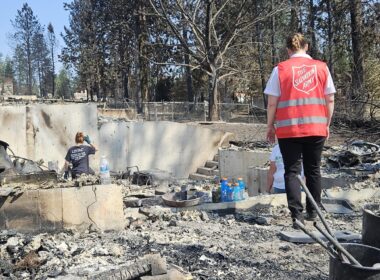
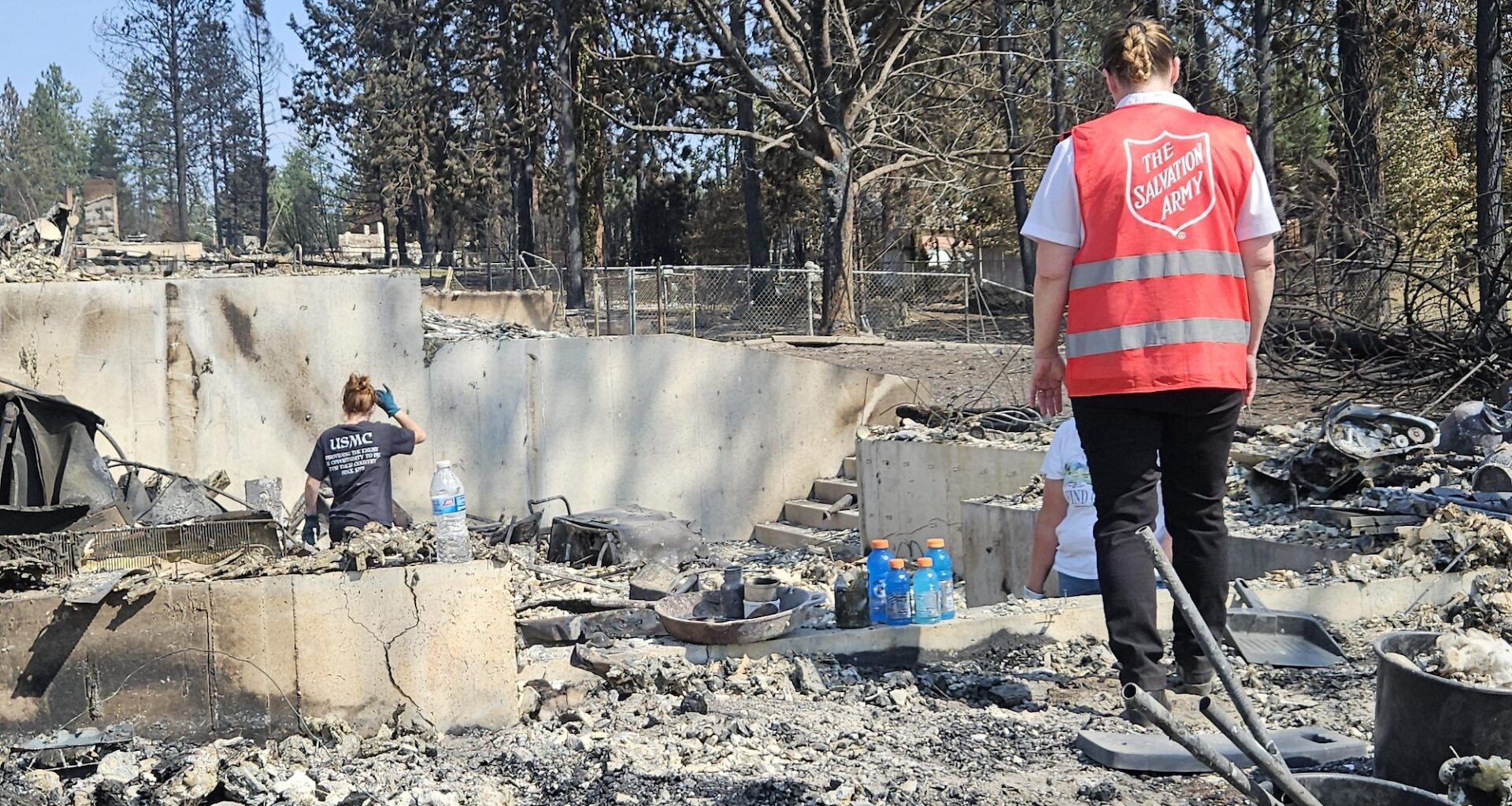
In the aftermath of the Spokane Complex Fires, Captain Kyna Kelley came across a group of six men and a woman, standing in the rubble of what she learned was once some of the group members’ home.
Kelley felt small next to the men—as a petite person, she noticed their height and their demeanor.
“They were all very angry,” she said. “I knew, in that moment, that I needed to try to stay very calm and de-escalate the situation, and so I allowed them to vent their frustrations.”
She sat with the woman, an owner of the home.
“All I had to do was put my hand on hers, and she started to cry,” she said.
Kelley had come upon the group on her rounds as an Emotional and Spiritual Care Officer with The Salvation Army’s Emergency/Disaster Services (EDS) response to the wildfires that are considered to be the largest primary structure fire in Washington’s history, destroying more than 800 structures.
She was deployed in the specialized role for about 10 days.
Emotional and Spiritual Care (ESC) is a hallmark of The Salvation Army’s work in EDS. It’s a ministry of presence—bearing witness to pain alongside people who are experiencing their worst day.
While officers learn aspects of EDS work at the College for Officer Training, further instruction is offered to support them as they support those in need.
“They’re pastors, but it’s a different situation on the disaster side,” said Territorial EDS Director John Berglund. “It’s heightened.”
In her typical work, Kelley serves men coming out of addiction at the Seattle Adult Rehabilitation Program (ARP). While she said she used many of the tools she’s developed over years in ministry during the deployment—like motivational interviewing—responding to the Spokane fires used a different, but related, set of skills she learned through specific training for ESC.
Over the last year, Kelley took two certified ESC courses: ESC in Disasters and Spiritual and Psychological First Aid. Additionally, she participated in a local ESC training.
“I was ready to say yes when this actual disaster happened,” she said, adding the training reinforced the importance of the ministry of presence.
“You don’t have to fix everything,” she said. “Sometimes your role is simply to be present.”
In the field, the coursework helped when leading an ESC team composed of local and retired Salvation Army officers.
Kelley supplied the team with a one-pager full of tips for best practices that covered key principles for new responders, like “listen first” and “offer hope without minimizing pain” along with a simple field approach: observe, connect, listen, stabilize and refer.
“It’s a very tricky situation to walk upon somebody who is standing in the middle of the rubble of their home and to just be there,” she said.
She and the ESC team made the practice of walking up to somebody and simply asking, “‘How are you?” and “Are you OK?”
“By doing that, it usually opens up the person to be vulnerable enough to just say, ‘No, I’m a mess. This is horrible,’” she said. “Then they start talking about their experience.”
Those conversations then can lead to next steps, some of which The Salvation Army is equipped to fulfill. In other cases, they can refer individuals to the Army’s community partners.
Once the tears began to flow while Kelley sat with the homeowner in the rubble, she said the mood changed throughout the group. Everyone began to calm down, she said.
Then the men told Kelley, “You know what? There is something good that came out of this. We found a diamond ring.”
“It changed the atmosphere and we were able to talk about, well, if we found a diamond ring, maybe there’s some silver linings that can come out of this,” she said.
The woman then accepted Kelley’s offer of prayer.
Amid the ongoing response efforts in Spokane, Roseburg (Oregon) Corps Officer Captain Edith Dye-Mabie joined the ESC team for 9 days.
Dye-Mabie also took the Spiritual and Psychological First Aid course, building on her degree in counseling. She said she was motivated to join the work in Spokane to serve others. By Aug. 13, the team had reported more than 4,000 moments of care and connection, according to The Salvation Army Northwest Division.
“Someone to listen, someone to care, someone to offer the smallest practical assistance that just might be the stepping stone to help begin processing the trauma and develop coping strategies. I have a desire to serve and this is compassion in action,” she said. “ESC is as important as physical assistance.”
Recently, at the corps Dye-Mabie leads with her husband, Captain Richard Mabie in Roseburg, Oregon, this message was driven home.
A new resident of the community who was a survivor of the 2018 Camp Fire in Paradise, California, engaged the pair in conversation.
The Camp Fire is considered to be the deadliest and most destructive fire in modern California history. The blaze resulted in 85 deaths, the destruction of 18,000 structures—decimating 95 percent of the town of Paradise.
“He shared that unlike some other agencies, The Salvation Army showed up and knew what they were doing,” said Edith Dye-Mabie. “He shared that the exhaustion could be read on everyone’s faces, but everyone with a shield continued to listen, answer questions, offer practical support and did it with a smile.”
He told her: “They looked me in the eye, invested their time and never made me feel like I needed to move on.”
Do Good:
 Download this page as a PDF