



Listen to this article
Across rural and underserved regions, service units provide vital care.
“We filled two needs this week,” said Salvation Army volunteer Richard Brown. “One was for pediatric dental surgery for a 4-year-old boy and the second was rental assistance for a 68-year-old man who was struggling.”
Those kinds of needs come up regularly through The Salvation Army Service Extension Unit Brown leads in Blaine County, Idaho. The unit assists individuals and families with food, housing, utilities, transportation and medical expenses.
Salvation Army Service Extension Units operate in communities without a formal Salvation Army presence. Unlike service centers, which have staff and facilities, service units run without employees or even a dedicated building—sometimes a volunteer works from a desk drawer where they keep vouchers for food, gas, or clothing and household items.
Across the U.S., The Salvation Army seeks to serve every zip code. Service extension units often form when The Salvation Army identifies a region without a local presence and reaches out to community leaders and organizations, or when an individual—like Brown—sees a need and takes the initiative to launch one.
Brown, who had volunteered elsewhere with The Salvation Army before moving to Idaho, contacted the closest Salvation Army location to learn how to start a local unit.
Now, 12 years after it began, the Blaine County unit continues to serve individuals and families across Idaho’s Wood River Valley, addressing ongoing needs in a region where high costs can quickly create financial strain.
In 2025, its Red Kettle holiday fundraising—with just a few volunteers—brought in $37,087 to support that work.
Colonel Olin Hogan is Southwest Divisional Service Extension Director, serving Arizona, New Mexico and Southern Nevada. Hogan said service units take different forms depending on the community. In Buckeye, Arizona, city employees help provide services. In Bisbee, a pastor runs the unit. In another location, a police department manages it.
Often, much of the work usually remains unseen. There are no buildings or signs to point to, just people who answer calls, meet with neighbors and help when they can. Some needs arise regularly—week to week. Other times, an emergency affects the whole community.
“Servants of Christ take many forms—some wear the uniform, and others simply love their neighbors enough to give their time, energy and compassion…That is the hallmark of a service extension unit volunteer: individuals who care deeply, give generously and serve faithfully, offering hope and help to [the] weary…Truly, they are heroes of caring in their community.”
Colonel Olin Hogan
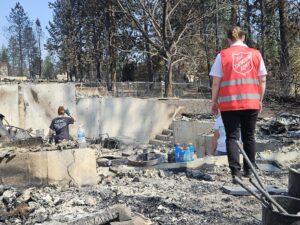
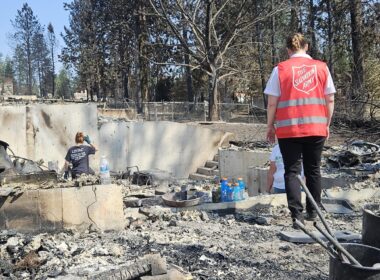
In Ruidoso, New Mexico, a service unit was operating out of a local business when wildfires and flooding forced residents to evacuate in 2024. The local network became a lifeline. Volunteer Steve Gomez distributed gas cards to displaced families, helping them return to a town where many faced rebuilding their homes.
The situation was extreme, but the approach was the same: someone local stepping in to help in the name of The Salvation Army.
“Service extension is such a unique part of The Salvation Army matrix of services,” said John Berglund, Western Territorial Emergency Disaster Services Director, following the Ruidoso disaster. “These volunteers take on the special role of stewardship in providing resources right in their own community and provide care and support for their neighbors.”
Service units have been part of The Salvation Army’s work in the United States since the organization began expanding in the U.S. in the late 1800s. While it could establish corps (churches) in larger cities, it was a challenge to sustain them in smaller areas.
In these communities, service units formed—groups of local volunteers focused on meeting immediate material needs. During World War II—as one of the founding organizations in the USO—The Salvation Army operated 201 service units specifically for the armed forces, which helped solidify this model of community support.
Today, the number of units and volunteers in the West is constantly changing as needs arise. Divisional data offers a glimpse of their impact.
In the Southwest Division, 30 volunteer-led units—supported by 195 volunteers—served 1,533 people from March 2025 to March 2026, providing assistance such as food, rent and utilities.
In the Cascade Division—Oregon and southern Idaho—volunteers run 89 service units, primarily from churches, police stations, community centers and city halls. Divisional Director of Service Extension Lloyd Potter said most units start small, focusing on a few core services: emergency assistance referrals, food boxes, utility/rent assistance if funding exists, and the Red Kettle Campaign.
“The biggest factor is almost always one committed local champion who believes in the mission and keeps things moving,” Potter said.
Often, service unit volunteers find creative ways to serve their communities.
In the Intermountain Division—Colorado, Utah, Wyoming and eastern Montana—Kristy Slaughenhaupt has served for more than 15 years in Canon City, Colorado, where she created a “toy closet” that allows parents to select a birthday gift for their child year-round. She also helps send youth to the division’s High Peak Camp, personally inviting and preparing about 30 campers each year.
“She serves her community in a volunteer capacity with love, joy and deep commitment,” said Kiara Cogan, Intermountain Divisional Assistant Director of Service Extension. “She represents The Salvation Army well. She is a treasure.”
The flexibility of service units allows The Salvation Army to reach communities far beyond its buildings, often serving as a pipeline for future growth in areas without an existing presence. Not every unit grows beyond its original form, nor does it have to.
In some cases, however, those small beginnings do expand. In Ridgecrest, California, for example, what began as a Service Extension effort in the 1980s has since grown into a full Salvation Army corps, with worship, programs and social services.
What matters is the consistency—the willingness of someone local to keep showing up. Across the West—and the entire United States—it’s these volunteers who enable The Salvation Army to serve in almost every zip code.
“Servants of Christ take many forms—some wear the uniform, and others simply love their neighbors enough to give their time, energy and compassion,” Hogan said. “That is the hallmark of a service extension unit volunteer: individuals who care deeply, give generously and serve faithfully, offering hope and help to the weary…Truly, they are heroes of caring in their community.”
Do Good:
- Every community is unique. So are our services. Learn more on how you can support The Salvation Army.
 Download this page as a PDF