

Listen to this article
A responsive robot dog is helping CARI redefine trauma-informed care.
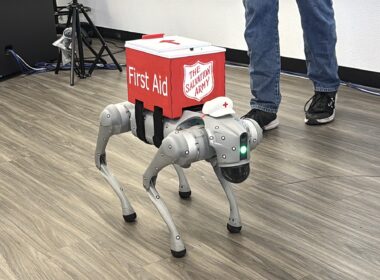
The day finally arrived—I would meet Cosmo, the robot dog who first captured my imagination in October 2025 when I saw a picture of him leading the pet parade at The Salvation Army Anaheim (California) Emergency Shelter (AES).
It was a good day for everyone involved.
The Salvation Army was holding a groundbreaking for its $18 million Center for Applied Research and Innovation (CARI) on the Center of Hope campus—home to the AES—and Cosmo was there, waiting for me.
With his four metal legs planted on the floor of an interactive demonstration booth, I watched children gather around him, getting him to sit, shake, stand up and roll over with the help of his handler.
When it was my turn, I engaged him likewise—enjoying my time—not having to wonder if this dog was friendly or skittish.
But why introduce a high-tech robot dog to a shelter campus? For CARI Director Dr. Benjamin Hurst, the answer has less to do with the technology and more to do with the people the campus serves.
“Cosmo sends an important message to our guests that they’re worthy of our best technology, our most forward-thinking applications,” Hurst said.
CARI’s leaders, Hurst and Director of Design Strategy and Research Dr. Mel Lee, trained as social workers. During their doctoral program at the University of Southern California, they focused on how to harness technology for social good.
To that end, Cosmo provides a predictable, non‑threatening presence that helps lower people’s guard and creates a starting point for conversations.
“Cosmo sends an important message to our guests that they’re worthy of our best technology, our most forward-thinking applications—that they’re a priority for our problem-solving skills.”
Dr. Benjamin Hurst
“When you talk about a shared experience that’s novel… he’s like a benign engagement object,” Lee said. “You don’t have to have a skillset, or have any knowledge of what he is. You can just show up and be in the moment, and there’s organic conversations happening out of curiosity.”
To emphasize safety, Cosmo’s handler uses a leash when he’s among the shelter community.
“People feel like he’s not just going to—like a dog—run at you,” said Alexandra Grosse, AES Design Research and Communication Specialist. “He’s on a leash. You’re OK.”
For the CARI team, the conversations and interactions around Cosmo will shape how they use robotics in the future to help people facing challenges.
Lee said the goal is to “get prepared for a future where we might see robotics being part of our shelter campus” by testing ideas now and inviting “people with lived experience… to be part of solutioning for what Cosmo’s next role could be.”
Cosmo is a test case for voluntary, trauma‑informed interaction.
Lee said the team first evaluated staff sentiment at the site before introducing Cosmo to guests. They carefully considered ethical boundaries like informed consent, making it “voluntary and optional to interact with Cosmo.”
Following his public debut at the AES pet parade, Cosmo assisted with The Salvation Army’s Red Kettle campaign, wearing antlers and bells.
“There were more people that engaged with the kettle and came over and even gave because he was there,” Lee said.
At the Center of Hope’s Pathways apartments, Cosmo served popcorn during a movie night where residents also brought their own pets.
“He will bring the people there,” Lee said, “but then it’s what you’re doing in the context of human engagement and interaction that’s the most special.”
The on-campus interactions are generating concrete ideas.
“Within our housing stabilization programs, I could imagine Cosmo as a designated emotional support companion,” said Client Ambassador Chris Campbell. “For individuals experiencing isolation, anxiety, or simply needing a friendly presence, Cosmo could become another tool for building connection and engagement.”
Campbell said shelter guests have pointed out that seeing a robot in action alongside employment coaches could also spark interest in technology and electronics careers.
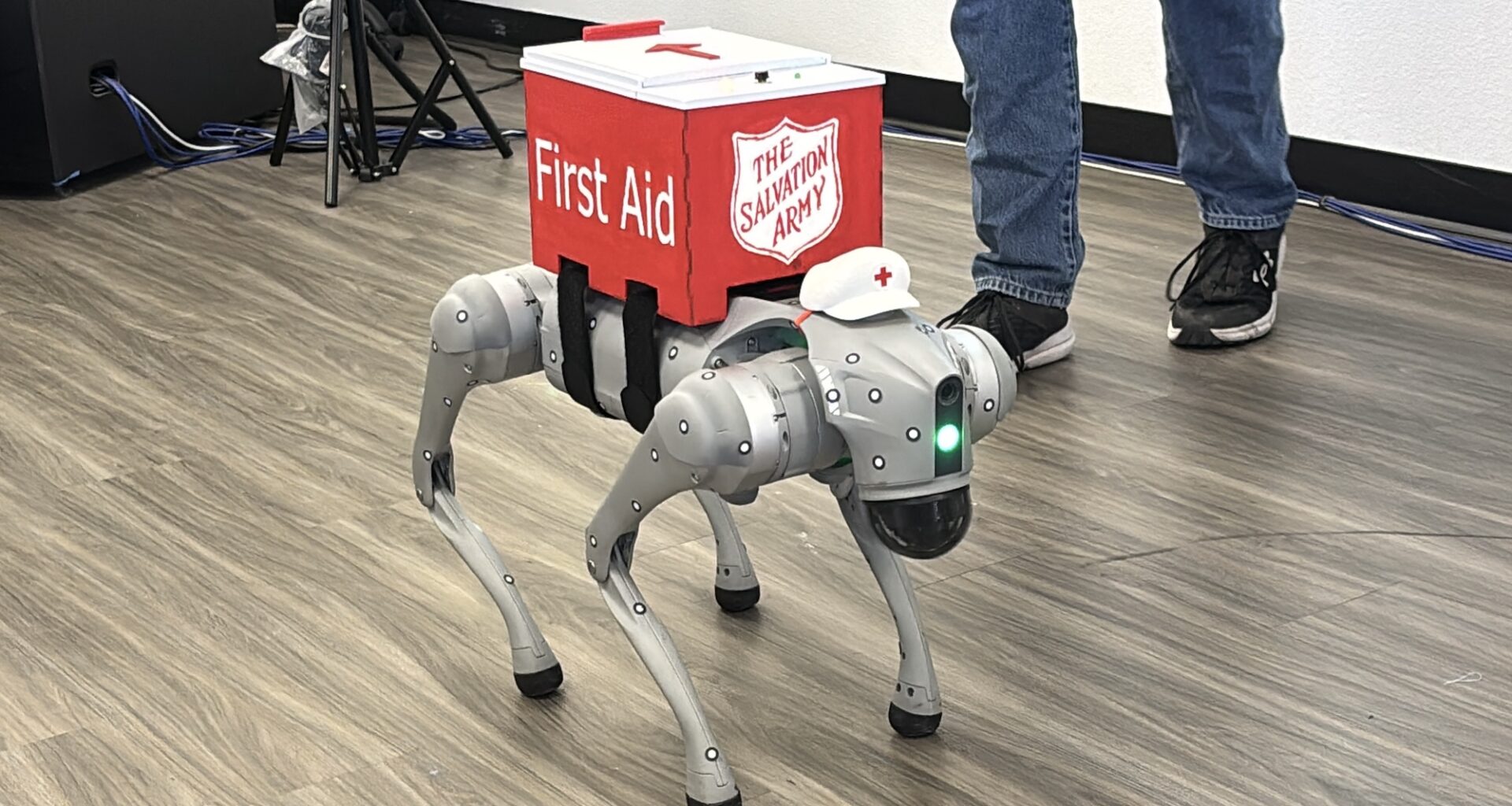
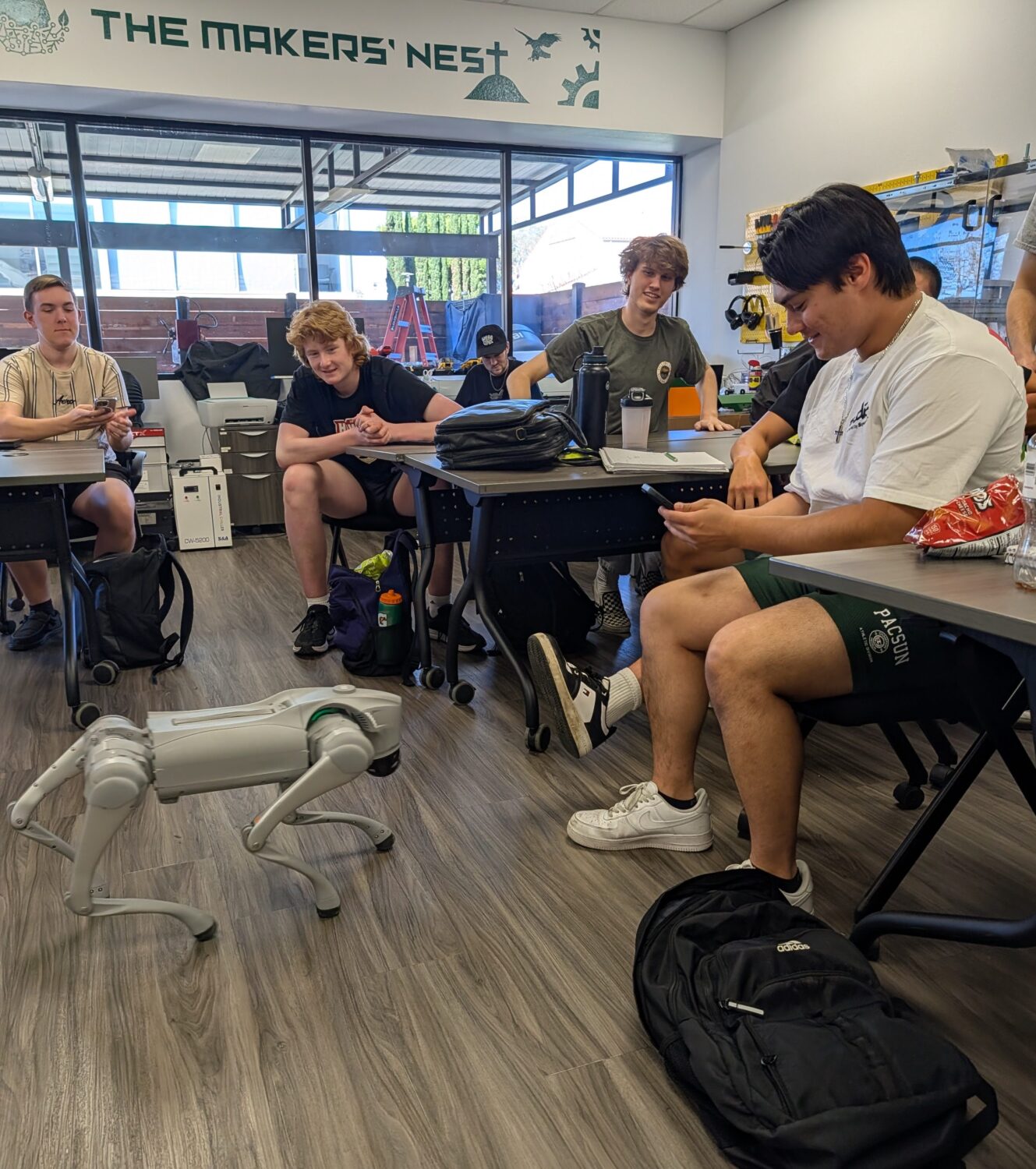
This past spring, Cosmo spent five weeks at Concordia University Irvine for an engineering design sprint. Students were challenged with making the robot more approachable. Their prototypes included adding ears, a tail and a removable medic box—reminiscent of St. Bernards with their rescue barrels.
That medic box is more than a prop. At the CARI groundbreaking, Cosmo’s handler said researchers are working to train the robot to respond to emergencies, including possible overdoses—carrying Narcan in the box and sending an alert for help.
But for CARI, what’s important isn’t just what Cosmo carries in his medic box; it’s the mindset he’s helping to form in the people designing him.
“We’re now using Cosmo to help teach empathy to engineering students and this human-centered design mindset,” Lee said.
CARI plans to co-teach a class at the university this fall on design and empathy for vulnerable populations, utilizing summer interns to test the student prototypes with shelter residents.
Researchers will track Cosmo’s interactions with shelter residents to evaluate how responsive technology can support individuals transitioning from temporary shelters to permanent housing.
Looking ahead to Cosmo’s next assignments, Lee said the real innovation isn’t the robot itself, but who gets to shape what comes next.
“We’re really mentoring folks on human‑centered design in working with vulnerable populations, and how we design with people, not for them.
“You’re not just someone to be served,” she said. “You’re part of building solutions.”
Do Good:
- The Salvation Army is committed to providing shelter and support to individuals and families in our community who are experiencing homelessness. By working together, we can make a difference. See more here.