





Listen to this article
A behind-the-scenes look at the journey to home.
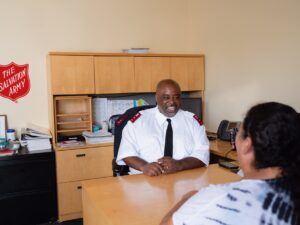
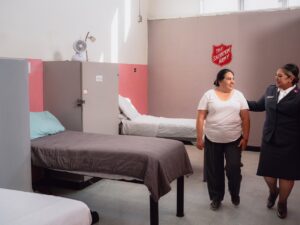
A phone call. A credit check. Another message left for a property manager. Inside The Salvation Army’s Tucson Hospitality House, finding a permanent home for a shelter guest rarely happens with a single conversation.
The process takes weeks, as individuals and families enter the 21-day emergency shelter and begin working alongside a case manager to navigate the search for stable housing.
“There are a lot of moving pieces,” said Kim Graham, a case manager at Tucson Hospitality House. “We help take care of many of the stressors for clients—they’ve already been through enough.”
When searching for housing, the goal goes beyond finding an available unit. Case managers work closely with clients to secure housing they can afford to maintain, reviewing income, exploring housing options, and contacting property managers willing to consider tenants exiting homelessness.
“We want to make sure each individual is safe for the long term,” Graham said.
According to research published in the National Library of Medicine, nearly one in four adults who exit shelter for housing return to homelessness within 18 months, often due to rising rent, loss of income or other challenges that make housing difficult to maintain.
Graham, along with other case managers at Hospitality House, works to prevent that cycle by connecting with property managers and community partners who help create housing opportunities clients can realistically maintain.
“Sometimes it just takes finding the right person who’s willing to work with us,” Graham said. “Those connections can make all the difference for clients.”
Housing within reach
On the receiving end of many of Graham’s calls is Property Manager Greg Eilmann, who oversees multiple housing complexes in Tucson.
Through his recent connection with Tucson Hospitality House, three clients have secured housing since 2025.
“He’s someone I can call, explain a client’s situation, and he’s willing to work with more complicated circumstances,” Graham said.
After Graham makes the initial contact, Eilmann helps identify apartments that may be a good fit for those preparing to leave shelter. Graham then gathers applications, confirms income and ensures tenants are moving into a place where they can feel comfortable and stable.
“Once we see someone walk through the door of their own place, there’s usually a sense of relief. They know it will take time to settle in, but they’re finally on stable ground.”
Kim Graham
“Our apartments target incomes between 40 and 60 percent of the area median income,” Eilmann said, explaining rents are designed to remain affordable for residents with limited income.
Individuals moving into the units managed by Eilmann also have access to supportive services through a partnership with La Frontera Center, which offers continued case management, health support and connections to other community resources.
“Sometimes people just need someone willing to give them a chance,” Eilmann said. “If we can help provide a stable place, we see how that can make a big difference.”
Community connections
To help build lasting stability, Graham seeks housing options in areas where individuals can foster connections and have access to services, transportation and community support. She then accompanies clients to tour units and meet with property managers, advocating on their behalf throughout the process.
“If someone has family or friends nearby, we try to find housing somewhere close by so they’re not starting over alone,” Graham said.
In some cases, she has even been able to help place former clients in the same complex.
“We want people to feel connected and happy where they live,” Graham said.
Research from the National Library of Medicine shows individuals exiting homelessness who are placed in communities where they can build relationships are more likely to remain stably housed and less likely to return to homelessness.
The apartment complexes Eilmann manages include shared spaces where residents gather for meals, movie nights and social activities.
Two weeks after moving into her unit with help from Eilmann and Graham, former Hospitality House client Rita Reeder said community involvement has boosted her mood and helped her feel at home.
“It’s nice to have people around who look after one another,” Reeder said, adding she enjoys living in a complex designed for adults 55 and older.
A lasting home
For individuals exiting homelessness, stable housing can mean more than just a place to live; it offers a chance to rebuild routines, relationships and a new sense of belonging.
“Once we see someone walk through the door of their own place, there’s usually a sense of relief,” Graham said. “They know it will take time to settle in, but they’re finally on stable ground.”
She recalled one man who recently moved into a complex managed by Eilmann.
“He just looked around and told us, ‘This is my home,’” Graham said.
Do Good:
- Change how you think, feel…and act. Get on the list for Good Words from the Good Word, a bite-sized email series from Caring Magazine to give you a boost of inspiration in 1 minute a day with a daily affirmation from Scripture. Delivered right to your inbox, it’s an email to help you start your day with goodness.
 Download this page as a PDF