




Listen to this article
At Christmastime, the spirit of generosity shines brightest. But we know giving isn’t just about what we give. It’s about how we give. And that’s why we’re calling this series: Give With Joy.
There’s nothing quite like the joy on a child’s face when they open a Christmas gift chosen just for them. It’s the kind of joy that lingers long after the wrapping paper is gone—the joy of being remembered, seen and loved.
For more than 40 years, The Salvation Army’s Angel Tree program has made that moment possible for children across the country. It has grown into a movement that now brings Christmas joy to more than a million children each year.
The idea was simple: invite the community to adopt a child by name, shop for their Christmas wishes, and then return those gifts so they could be placed into the hands of families who might otherwise go without. Behind that simple plan are countless stories of connection and hope—families who breathe a sigh of relief, children who go back to school with new clothes, volunteers who find purpose in serving.
Today, you’ll hear from people whose lives have been touched by these gifts. Captain Yohani Ortiz shares her own story of receiving gifts as a child and how it shaped her life. And then, you’ll hear from Marlene Klotz-Collins, who helped launch the Christmas Angel program in Phoenix and has volunteered faithfully for four decades.
Because at Christmastime, joy shows up in many faces—and often, it starts with a simple paper angel.
Listen and subscribe to The Do Gooders Podcast now. Below is a transcript of the episode, edited for readability. For more information on the people and ideas in the episode, see the links at the bottom of this post.
* * *
Captain Yohani Ortiz: I grew up in San Jose, California. My grandmother was a long-time Salvationist, and when my mom and I moved here from Honduras, I was eight years old. We got plugged into the corps there and they quickly included us. My first Christmas experience where we had, I believe it was a newspaper, the employees from a newspaper, they adopted my mom and I. And I remember them coming to our apartment and everything was wrapped in purple, silver, and it was really wrapped beautifully. And they brought a basket of food and gift cards. And I remember getting a watch. I was so mesmerized by it, I thought, “Man, wow, this was so cool.” And it was my first introduction to the generosity of other people. Now, I’m a teenager, and I remember thinking like, “Wow, these people went out of their way to make it extra special for us.”
Not just for me as a teen, but for my mom as well, getting her bedding, and I remember the food and stuff for her as well for the house just to make Christmas special. I was just so blown away. It was at a point in my life where I hated Christmas. I hated being away from family. I hated that my mom worked so hard. I was by myself. My mom lived paycheck to paycheck. My dad passed away when I was little, so it was just her making ends meet. So we struggled quite a bit. When they adopted us that year, it was such a relief. It was like this little glimpse of what Christmas was supposed to be for a child.
Christin Thieme: How did all of those experiences influence you wanting to become an officer?
Captain Yohani Ortiz: Oh, well, I mean, I get to pay it back. I get to pay it forward. And remembering that feeling of that somebody was thoughtful enough and caring to make my Christmas special despite of my circumstances and how I was feeling, now I get to do that for someone else. I get to be that beacon of hope that even when… I’ve been studying the Book of Habakkuk, and he goes through these complaints of why is there so much injustice and chaos and destruction and why are you letting all this happen? And so in our food pantry, we see all these people coming in so broken, so desperate for just a break in life. And we get to fill in the gap.
And so after we go through our complaints, there’s this joy that comes in knowing that there’s hope at the end of the tunnel, that there’s a God that provides. And so we get to be those hands and feet of Jesus. And that really is my motivation, not only for Christmas, but all year round I get to give that feeling back to a child. So now just being able to walk with the parents and help fill in those gaps where they’re trying to figure out how do I pay bills or rent this month. We’ve seen such an increase in our rental and utility assistance requests, 40 percent at least.
Christin Thieme: Wow.
Captain Yohani Ortiz: And so now with the holidays coming up and the cost of everything, it’s stressful. And so we get to be that relief for a lot of the parents.
Christin Thieme: Yeah. Why do you think toys are an important part of that? Or Christmas gifts really, not just toys. I mean, there are real concerns around hunger and shelter and so many things. Why do you think the gift aspect of that is part of what The Salvation Army does?
Captain Yohani Ortiz: I mean, from a child’s standpoint, you’re not thinking about rent and you’re not thinking about food. You’re not thinking about the things that make a household run. But there’s so much joy that comes from a toy. Think of a child like mine, it’s just part of their DNA to play with something, to build, to have that stuffed animal that it brings them comfort. And so I think that the toys itself, although they’re not going to bring relief to the household itself, but to a child, that could mean the world.
*
Christin Thieme: Captain Ortiz’s story reminds us of the heart of why The Salvation Army does Angel Tree: a child’s face lighting up on Christmas morning, and the lifelong impact of knowing someone cared.
But behind every Angel Tree gift, there are also volunteers and community leaders who make it possible year after year. In Phoenix, the Angel Tree or Christmas Angel program has been running for four decades, now making wishes come true for some 30,000 children each season. And one person who has been there from the very beginning is Marlene Klotz-Collins.
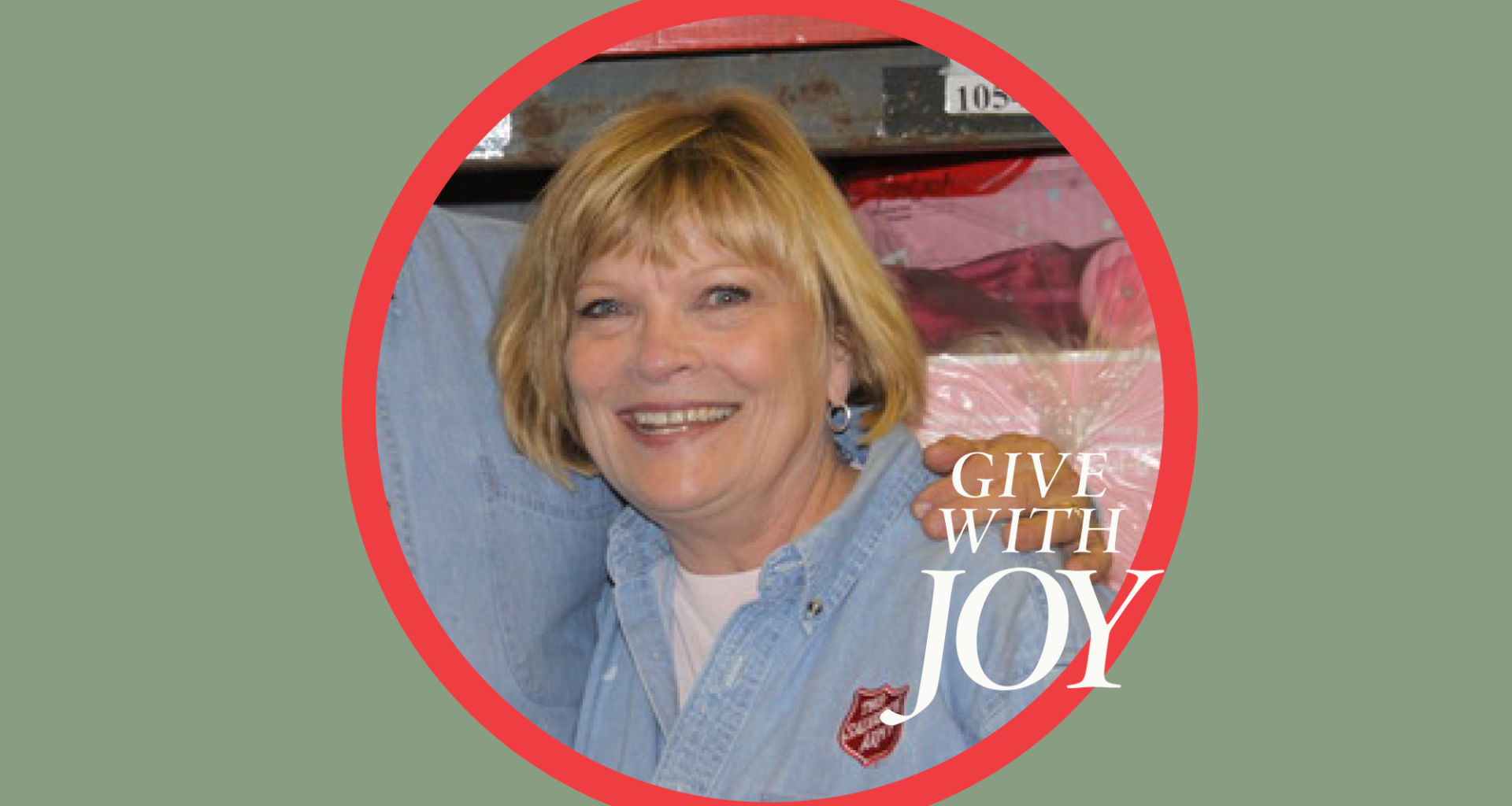
Marlene is a member of The Salvation Army’s National Advisory Board and has faithfully served with the Christmas Angel program in Phoenix for 40 years. For her, it wouldn’t be Christmas without helping in the warehouse and seeing those bags of gifts go out to families.
*
Marlene Klotz-Collins: The very first year we started, in 1986, and at that time, as recent as 40 years ago, it was really hard for The Salvation Army to have new toys for children, quality toys. They did, we did what we had to do, that was very difficult. At that time, there was a local radio station that was doing a sales promotion in a pet store, and they did tabletop Christmas trees, a couple tabletop Christmas trees, put the names of dogs and cats, and let people support local shelters by taking that. So, our marketing committee, which was basically another woman, and myself, and our PR person, and a Salvation Army officer, we said, you know what? If they can do that for pets and it works, why don’t we take that concept to a mall and see what happens? So, we chose one mall, which at that time was one of the more prominent malls in Phoenix, and good friends, we did so much with their marketing director.
So, our marketing person and I and the officer went and met and said, Nancy, could we put some Christmas trees up in your mall? She said, yes, we put three trees up, my colleague on the advisory board, her artist designed a really sweet Christmas Angel tag, and at the time I was just starting at Channel 3, which was our ABC affiliate, setting up their community relations department. Was leaving the CBS affiliate and was very intentional about not saying anything until I got over to Channel 3. First day, I went into a general manager, who was a long time dear friend, and said, we’re going to do this Christmas Angel… Actually, we called it Secret Santa for the first time.
And can we support it as a station? He said, absolutely. And I’ll tell you, Christin, we were all in on that. By the time everything was set up, and we did it in fairly short order, looking back now, because I started the station in September, we flooded our station with promotion spots, and also we were, every day on every newscast talking about Secret Santa.And that first year we had new toys for 3,200 children. It was a real blessing, huge blessing. They were such great toys, that we could never have afforded for the children. So, that was it, it started in 1986, with three Christmas trees in one mall to try this experiment.
Christin Thieme: Kind of incredible to think about that history, and how it really originated with a few people saying yes to this idea and running with it from there, and being excited about it and willing to support and help people in their community. I love it. Did you ever imagine then that it would grow into something that now touches thousands of families every Christmas? And give us a little picture of what it’s like today?
Marlene Klotz-Collins: I get very emotional, so… I don’t think back then, I thought, what’s this going to look like in 40 years? We were just more like, what’s this going to look like at the end of the season? And it probably really didn’t strike me maybe until year 25 or 30, and I thought, wow, to be able to be involved with something as sacred, if you will, as Christmas Angel, and with The Salvation Army, and to be around long enough and deeply involved long enough to have watched the whole thing, it’s a blessing. It really moves me, it’s very emotional.
Christin Thieme: Yes, absolutely. And I know you said last year some 30,000 children received toys through this program, so it has definitely grown, and just has this incredible impact. You called it sacred, can you share more about why you use that word?
Marlene Klotz-Collins: I think that the mission of The Salvation Army is sacred, and we’re serving that mission, and doing what God would have us to do. We have all these people who want to help other people, and we have this really fun way to do it, a very special way to do it, and the stories that have come out over the years, if you spend any time at all at one of our Christmas trees, or even at the warehouse, the stories you hear, and the reason why people take tags off of a Christmas tree, why they shop for the child they do, it could be a child that they lost, one of their own children, or grandchildren who are cross-country and they don’t get to be with them, or first responders will come just out of gratitude for what The Salvation Army has done for them in situations involving those disasters. It’s across the board, and the stories are so rich, so profound, and they just really touch my heart.
Christin Thieme: Is there one story or memory that really stands out to you from throughout all the years?
Marlene Klotz-Collins: You know what? There were so many, but it’s interesting you asked that. One that I always think about, I was working at the warehouse one night, and I worked at Channel 3 at the time and was also on the advisory board, I got the call from the assignment desk, and he said, “Marlene, this young lady is trying to reach you, she’s a student from a local high school and she says it’s important.” So, of course I called her right back. Her family had moved from Pretoria the Christmas before, and she had seen our promotion spots and our stories for Christmas Angel. So, for Christmas that year, she took a buttercup and slit the top and made one for both of her parents and decorated it and called it a dime a day, ADAD. And she said she gave that, each one to both of her parents last year, at Christmas, they saved $36.50, and her idea was if we could save a dime a day, they would have enough money to do Christmas Angel this year.
She was barely in this country, and she had seen our spots and seen our stories, that has just stuck with me for so long. And then, a flip side answer to that, I have a couple of friends who have supported Christmas Angel since we started, financially and otherwise, but they’re the guys who I have called when we’ve been out of toys, we’re almost out of toys, and I’m at the point of… Those of us who really work the warehouse, you know when you’re going to have a problem and going to be out. I’ll call one or both of these guys, in tears, really, it chokes me up, because I just say, we’re going to be out of toys and we need help. And it’s just, how much do you need? And I have the check literally within hours.
If I have it at night, they’ll bring it by the next morning or later in the morning if I call them during the morning. But my husband and I have gone to Walmart more than once to buy toys at 10:00 at night after we finish at the warehouse, just to help us, and that’s not unlike what officers and staff members do during the day, if we have to. But those two stories. Oh. And so I went and I met that young lady at the mall, I called our assignment desk back right away, and said, we’ve got to schedule this story, I’m going to meet her tomorrow, we sent a camera and we produced a story about a dime a day, and I will never forget a dime a day.
Christin Thieme: I love that. Yeah, this only works really with people’s hearts being touched and wanting to be involved. I know you’ve said before it wouldn’t be Christmas if you and your husband weren’t at the warehouse. What keeps you coming back year after year? This is an incredible amount of work, but why is it so personally important to you?
Marlene Klotz-Collins: It’s particularly important to me, and I think I really speak for my husband too, because he married into it 29 years, he was working here before we got married, so he’s at the 30 year mark. It’s magical, it’s a blessing, it’s much more of a blessing for me. I get more out of it than I could ever give back to it. It truly is. It just blesses my heart because I know why we’re down there, there is so much work to be done, the fact that I was blessed to be part of at the very beginning, I just can’t imagine Christmas without Christmas Angel.
Christin Thieme: Yeah. We keep mentioning the warehouse, and you’ve sent some photos of it, so we’re going to include those in the show notes so people can flip through and actually see inside, what we mean by the warehouse.
Marlene Klotz-Collins: Oh good.
Christin Thieme: But can you explain a little bit about what is that process? What does that look like from somebody donating toys to a family receiving them, what’s it like to stand in that warehouse and just see row after row after row of all of these gifts that are ready to go out to families?
Marlene Klotz-Collins: I so appreciate you recognizing that and understanding it. And every night when we do this for nine nights and two Sunday afternoons to prepare the warehouse, but what we’re doing basically is we have cages for every day of distribution. We have 11 days of distribution. So, each of these cages are, if it’s a good night, they are overwhelming filled with toys. Our goal is to take them out of the cage, each bag has a child’s code number that tells us a lot of information, most importantly, the family number, which is from one to 888. So, we will pull, volunteers will take the individual bags out and take that code number, find section 888 on the shelves, and put it there. And when we’re finished with that part of the process, which we call shelving, when we’re finished with that part, we have 14 rows of shelving units filled with individual toys.
Then we assign to each volunteer, and we record 135 volunteers a night, each volunteer takes stacks of registration forms… And this is all set, my husband has done a schematic and lays this out in truly brilliant fashion to keep everyone spread out. And everyone takes a pile, nine at a time, and they’ll go family by family, and they’ll say, okay, family 25, do we have six kids? We don’t. So, we go to another part of the warehouse where we have pre-made bags for children according to age and gender, we’ll pull whatever we need to fill up what’s left for that registration, and then we take all of those individual bags and put them into one big red bag. So, we go from 888 absolutely empty shelves, to filling them up within 30 minutes, and then we go through, we check our work, we load up the red bags, and it takes about two and a half hours.
And I’ll tell you, Christin, every year I have people say to me, if they’re first timers, they walk in and they see all of these toys, and they are overwhelmed. And I can understand that. But they can’t even imagine that those toys can be organized by the end of the evening. And we start at 5:30, give instructions, and then begin at 5:45, and we’re usually finished by 8:30. And it goes from those three steps. And it’s remarkable.
Christin Thieme: It is.
Marlene Klotz-Collins: And I never tire, I never tire of looking at those before and after pictures, to see what those shelves look like. And each one of those bags represents hope, it represents joy, it represents love, and a community that cares. Our community is so generous. These toys that come in, The Salvation Army could never afford to provide these types of toys for children. And people just give, even in hard years, they give give, they give. It’s remarkable.
Christin Thieme: Yeah, you’ve seen it year after year, truly, I think it’s clear this really resonates deeply with the community, and has made it a powerful tradition there for you. Beyond the gifts themselves, what do you think this program means for the parents and the children who might otherwise very literally not have something to open up on Christmas morning? Who are these families?
Marlene Klotz-Collins: These are families who are a paycheck away from being on the street. They can be in our shelter, a very few of them, relatively speaking. We help 50,000 children in the Valley, and we help about 30,000 just from the main warehouse you and I are discussing. But this is Christmas, and I think it’s the point that it’s almost even more than providing for Christmas because so many of these families are dealing with rent and utilities and food and different circumstances that some of us can’t even imagine what they’re juggling all at the same time. And to put Christmas, and how am I going to take care of my family, just for that, it’s a huge gift. It’s a relief, you can only imagine being a parent in that situation. And some of these families, we deal with families with eight to 10 children. It’s a lot. How can they even deal with that?
So, it’s a blessing for them. And what is truly yet another blessing, and another dimension of this, are the people who come back to us, the people who work at the warehouse. I had a young lady, I was just looking at her picture last night, she said, “You know what? I was on a Christmas tree. For four years I was on a Christmas tree. I wouldn’t have had Christmas had it not been for The Salvation Army.” And now she has a job, and she’s a parent, and she’s working at our warehouse. Those are the kinds of stories that we hear at the warehouse, we hear at the trees, people come back, and even when they really can’t afford to be buying for someone else.
Christin Thieme: That’s incredible. After 40 years of serving in this way, what do you hope for the future of the Christmas Angel program looking ahead?
Marlene Klotz-Collins: I of course want it to continue. This is such a deeply rooted tradition in our Valley and state. Just continued wisdom in growing the program, the way that we express just the technology, how much it’s changed in the 40 years, and the way that we’re doing that. Staying with the mission, keeping with the mission, and just pouring your heart into it. And I know there will be officers and staff and people on the side with Channel 3, our TV sponsor, that they would continue to embrace. And I would just want to mention too about, because I was the brand new community relations director when we started this program at Channel 3, and I was at the station for about 20 years. But the station has changed ownership, it’s changed management, I am very close with the person who took my position, and she’s now the station manager.
They love the Army, and I give them so much credit. This was the hallmark of our community service programs when I left Channel 3, and they have maintained that. And I can’t even imagine this doing anything except continuing to flourish. So, just the ability to respond to the technology that’s out there, the wisdom, profound wisdom that you need, the enthusiasm and the heart, and I think within all those components, we have that with officers and staff.
Christin Thieme: Of course, this is not the only way that you’re involved with The Salvation Army, your involvement runs deep, as you might say. Can you tell us a little bit about why do you love The Salvation Army? Why are you involved?
Marlene Klotz-Collins: At every level, it just fills my soul and feeds my heart. It really does. You can’t out give the Army. So, as much as I love it, and I’m into my 43rd year on the local board, and I’m very close to finishing 27 years on a national advisory board, you know what? I get the blessings. And it’s such an honor to serve an organization like The Salvation Army. There’s no doubt in my mind, it is the most beloved organization in the world, we’re the largest provider of social services of any organization in the world, I love our history, I love our heritage, I love everything about the Army, and anything I can touch, I just want to touch because it’s just a blessing.
Christin Thieme: Well, we are lucky to have you, Marlene. For somebody listening who wants to adopt an angel or wants to get involved with The Salvation Army in some way this Christmas, what would you recommend?
Marlene Klotz-Collins: Contact your local Salvation Army. The Salvation Army has different programs in different areas, all of them have some kind of Christmas Angel. They may not run their program like we do. The name that I think is used around the country more is Angel Tree, the Angel Tree program. Contact the Army. And if it’s not Christmas Angel, there are all kinds of holiday programs, and we are always looking for volunteers. It’s hard not to get hooked on that when you do it. I have people walk out of the warehouse every year saying, I want to come next year and bring my Bible study class, my Girl Scout troop, my other group of a company, it’s hard not to fall in love and stay in love, it’s all things good.
Christin Thieme: I love it, Marlene. Well, finally, as a last question for you, what is giving you hope lately?
Marlene Klotz-Collins: I’ve just seen God working in some very powerful, unique, even unusual ways in answering some prayers of different things going on, and I just love the way he works. I just love the way he works in our lives, when we let him. And then, I have a lot of hope for this year’s Christmas Angel program. I start working on Christmas Angel, well, right after Christmas, but really, I drill down and start recruiting my volunteers in July. And now, everything’s coming to a head, and I’m really finalizing all of those details and getting ready to be at the warehouse all the time. We’re going to have a great year, and the people who are participating, whether they’re giving or receiving, it’s going to be a blessed year for them.
*
Christin Thieme: Hearing Captain Ortiz share her childhood memories reminds us of the joy on a child’s face when they open a Christmas gift chosen just for them. And listening to Marlene Klotz-Collins reflect on four decades of serving with the Christmas Angel program shows us the other side of that joy—the joy of giving, of making Christmas brighter for families who might otherwise go without.
That’s the beauty of Angel Tree: it’s more than just gifts. It’s dignity for parents, joy for children, and hope for families. And it happens because people like you choose to get involved.
This Christmas, you can be part of that story. Visit your local Walmart and look for the Angel Tree display. Pick a tag, shop for a child’s wish list, and return your gifts. Or, shop online using Walmart’s Spark Good Registry, and The Salvation Army will make sure your gifts go straight into the hands of a child in need. Head to the show notes for today’s show for a direct link.
Because when you adopt an Angel, you’re not just giving toys or clothes—you’re giving a child joy, and reminding them they are seen and loved.
So this year, would you consider adopting an Angel? Together, we can put smiles on children’s faces and share the joy of Christmas with families across the country.
Additional resources:
- Help The Salvation Army give with joy this Christmas season by supporting the Angel Tree program.
- Join us in giving joy to families who are experiencing poverty, hunger, job loss and more. Your generosity offers joyful reassurance that even during our most challenging times, we are not alone.
- Make Advent meaningful with a simple paper chain countdown focused on love received and love given. Sign up for the free download.
- If you are enjoying this show and want to support it, leave a rating and review wherever you listen to help new listeners hit play for the first time with more confidence.
Listen and subscribe to The Do Gooders Podcast now.
 Download this page as a PDF